
Past Lectures
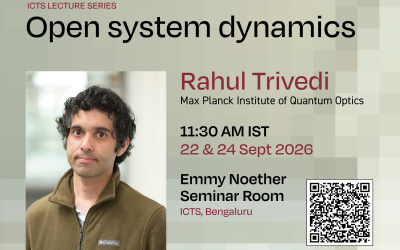
Rahul Trivedi (Max Planck Institute of Quantum Optics)
22 September 2026, 11:30 to 24 September 2026, 13:00
Emmy Noether Seminar Room
I will provide an introduction to both the physical and mathematical aspects in open system. I will first introduce the Markovian model for open quantum dynamics, and present an overview of the characterization of their steady-state properties. I will focus on both the case of time-independent as...more
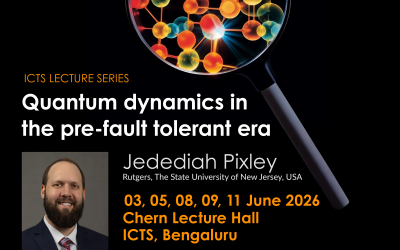
Jedediah Pixley (Rutgers, The State University of New Jersey, USA)
03 June 2026, 11:30 to 11 June 2026, 13:00
Chern Lecture Hall
As quantum devices move from the NISQ to the pre-fault tolerant era, understanding the nature of quantum dynamics requires the combination of unitary evolution, mid-circuit measurements, and conditional feedback, which are the required ingredients for quantum error correction. At the same time,...more
Raju Venugopalan (Brookhaven National Lab, USA )
20 January 2026, 14:00 to 06 February 2026, 11:30
Emmy Noether Seminar Room
Date and Time: 20 January 2026: 2:00 PM to 3:30 PM (IST) 22 January 2026: 11:30 AM to 1:00 PM (IST) 27 January 2026: 2:00 PM to 3:30 PM (IST) 29 January 2026: 11:30 AM to 1:00 PM (IST) 30 January 2026: 2:30 PM to 4:00 PM (IST) 03 February 2026: 2:30 PM to 4:00 PM (IST) 05 February 2026: 11:30 AM to...more
Abhishek Dhar (ICTS-TIFR, Bengaluru)
19 January 2026, 14:00 to 02 February 2026, 17:00
Madhava Lecture Hall
Stochastic interacting many-particle systems as well as Hamiltonian systems will be discussed in the context of arriving at hydrodynamic equations from microscopic ones. These lectures will discuss issues related to the derivation of Euler, Navier-Stokes and Fluctuating hydrodynamics. Lecture 1: 19...more
Jerome Peter Gauntlett (Imperial College, London)
18 November 2025, 14:00 to 21 November 2025, 11:30
Chern Lecture Hall
Date & Time:: 18, 19 November 2025 at 2:00 PM - 3:30 PM (IST) and 20 November 2025 at 11:30 AM - 1:00 PM (IST) Important BPS quantities, including central charges, black hole entropy and the on-shell action, can be computed for supersymmetric solutions of supergravity with- out ever solving the...more
Nikita Nekrasov (Stony Brook University, USA)
18 September 2025, 14:00 to 02 December 2025, 15:30
Feynman Lecture Hall
Lecture on 02 December 2025 Stands Cancelled Date: 18 September 2025, 13, 14, 27, 28, October 2025, 03, 04, 10, 11 November 2025 and 01, 02 December 2025 Time: 2:00 PM - 3:30 PM (IST) Graduate level introduction to modern mathematical physics with the emphasis on the geometry and physics of quantum...more
Frank den Hollander (Leiden University, The Netherlands and Faculty Associate of ICTS)
15 September 2025, 11:30 to 19 September 2025, 13:00
Madhava Lecture Hall and Feynman Lecture Hall
Date & Time: 15 September 2025 from 11:30 - 1:00 PM (IST) in Madhava Lecture Hall 19 September 2025 from 9:30 - 11:00 AM (IST) and 11:30 - 1:00 PM (IST) in Feynman Lecture Hall Outline: (3 lectures of 90 minutes each) Lecture 1: Background and motivation for Interacting Particle Systems (IPS)...more
Hugo Touchette (Stellenbosch University, South Africa)
01 November 2024 to 05 November 2024
Emmy Noether Seminar Room, ICTS Bengaluru
Reinforcement learning deals with how an agent decides on actions to take in an environment, while intending to maximise some notion of a reward. This course will cover the basic theory of reinforcement learning, based on Markov decision processes and dynamical programming, as well as basic...more
Minhyong Kim (University of Edinburgh, UK)
03 September 2024 to 05 September 2024
Feynman Lecture Hall
In the 1960’s Barry Mazur called attention to an ‘analogy between knots and primes’, in terms of which he conceptualised the Main Conjecture of Iwasawa Theory relating p-adic L-functions and ideal class groups. This analogy led his research away from topology and into number theory, after which he...more
Madabusi Raghunathan (Distinguished Professor, UM-DAE Centre for Excellence in Basic Sciences & Honorary Fellow, TIFR)
24 July 2024 to 02 August 2024
Madhava Lecture Hall
In these lectures I will outline a proof of the Atiyah-Singer Index theorem. I will begin with the definition of the symbol $\sigma_l$ of a linear differential operator $L$ and the notion of ellipticity of $L$. I go on to define the analytic index $i_a(L)$ of a linear elliptic differential operator...more

Pages