
The Einstein Lectures series was initiated in 2015 as part of the centenary celebration of Albert Einstein’s General Theory of Relativity. Schools, colleges and other organizations can request to organize a lecture anywhere in India. Selected partner organizations will work with the ICTS in selecting an appropriate speaker depending on the date and venue of the lecture, and the nature of the audience. Einstein lectures cover a wide spectrum of topics in physics and related areas. Speakers range from early-career scientists to international luminaries. ICTS will support the travel and honorarium for the speaker. Partner organizations are expected to take care of the local organization.
Contact: einstein . lectures @ icts . res . in
Upcoming Lectures
Sidney R. Nagel (University of Chicago)
06 December 2025, 15:00 to 16:30
St. Joseph's University, Bangalore
Abstract: I will emphasize the surprises and elegance of how liquids produce the texture of our lives. Examined closely, many things that we take for granted are astonishing. Consider a simple liquid drop as it falls. It breaks into two pieces where not only the topology changes but where the...more
Past Lectures
Efi Efrati (Weizmann Institute of Science, Israel )
11 November 2025, 15:00 to 16:30
Seminar Hall, Yuvaka Sangha, 31st Cross, 11th Main Rd, 4th Block, Jayanagar, Bengaluru
Abstract : When humans build, we place each piece where it belongs in the final structure. Nature has no such blueprint. From the growth of tissues to the self-assembly of proteins, natural structures take shape through local rules—simple instructions followed by each part without awareness of the...more
Scott Hughes (Massachusetts Institute of Technology, Cambridge, USA )
07 November 2025, 15:30 to 17:00
PES University, Ring Road, Banashankari 3rd Stage, Bengaluru
Abstract: Einstein’s general theory of relativity teaches us that gravity radiates, producing waves which exert a tidal stretch and squeeze as they propagate across the universe. Because gravity is the weakest fundamental force, Einstein believed that this radiation would never be measured...more
Samriddhi Sankar Ray (ICTS-TIFR, Bengaluru)
27 February 2025, 10:30 to 12:00
K.N.V.Sastry Auditorium, mLAC
​ Abstract: Turbulent flows are ubiquitous. They are central to natural processes from the depths of the oceans to the heights of our atmosphere, and beyond. And yet, turbulence remains one of the great unresolved problems in classical physics. But what does this statement really mean? In this...more
Rajaram Nityananda (ICTS-TIFR, Bengaluru)
29 October 2024, 11:30 to 13:00
R V College of Engineering, Bengaluru
Abstract: S. Chandrasekhar, born on the 19th of October, 1910, was one of the outstanding astrophysicists of the twentieth century. His career was also unique in falling into distinct phases, each marked by substantial published work, culminating in a book. The very first phase, in which he derived...more
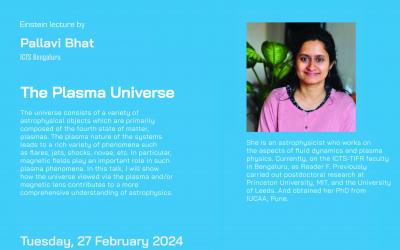
Pallavi Bhat (ICTS-TIFR, Bengaluru)
27 February 2024, 11:00 to 12:30
Maharani Lakshmi Ammanni College For Women Autonomous, Bengaluru
Abstract: The universe consists of a variety of astrophysical objects which are primarily composed of the fourth state of matter, plasmas. The plasma nature of the systems leads to a rich variety of phenomena such as flares, jets, shocks, novae etc. In particular, magnetic fields play an important...more
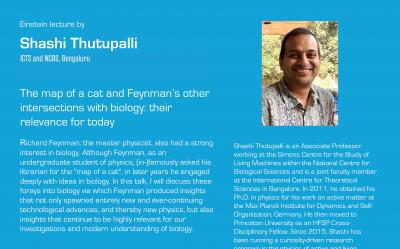
Shashi Thutupalli (ICTS and NCBS, Bengaluru)
26 November 2023, 11:15 to 12:00
Kiru Rangamandira, Mysore
Abstract: Richard Feynman, the master physicist, also had a strong interest in biology. Although Feynman, as an undergraduate student of physics, (in-)famously asked his librarian for the "map of a cat", in later years he engaged deeply with ideas in biology. In this talk, I will discuss these...more
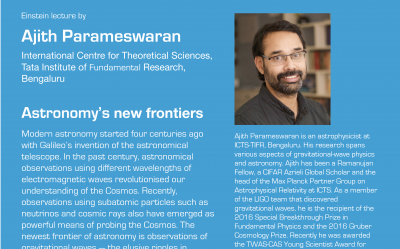
Ajith Parameswaran (International Centre for Theoretical Sciences)
06 October 2022, 10:00 to 11:30
St Marys Convent Girls HSS, Market Road, Ernakulam
Abstract: Modern astronomy started four centuries ago with Galileo’s invention of the astronomical telescope. In the past century, astronomical observations using different wavelengths of electromagnetic waves revolutionised our understanding of the Cosmos. Recently, observations using subatomic...more
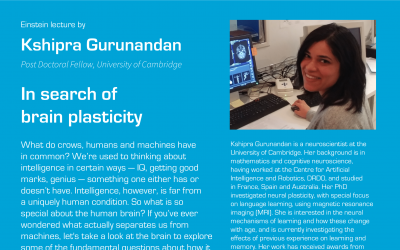
Kshipra Gurunandan (University of Cambridge)
05 September 2022, 11:00 to 12:30
School of Sciences,Jain University, No. 34, 1st Cross, J C Road, Bengaluru - 560027
Abstract: What do crows, humans and machines have in common? We’re used to thinking about intelligence in certain ways — IQ, getting good marks, genius — something one either has or doesn’t have. Intelligence, however, is far from a uniquely human condition. So what is so special about the human...more
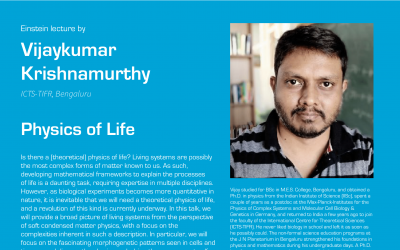
Vijaykumar Krishnamurthy (International Centre for Theoretical Sciences-TIFR, Bengaluru)
21 November 2020, 11:00 to 12:00
Online
Is there a (theoretical) physics of life? Living systems are possibly the most complex forms of matter known to us. As such, developing mathematical frameworks to explain the processes of life is a daunting task, requiring expertise in multiple disciplines. However, as biological experiments...more
Abhishek Dhar (ICTS-TIFR, Bengaluru)
28 February 2020, 09:30 to 10:30
Kuvempu Auditorium, C V Raman Block, REVA University, Bengaluru
The talk will describe how physicists and mathematicians find hidden patterns and information in apparently random looking events. I will try to do this through the examples of the Random Walk, Brownian Motion, many particle systems in Statistical Physics, and finally a card trick. Download Postermore

Pages