

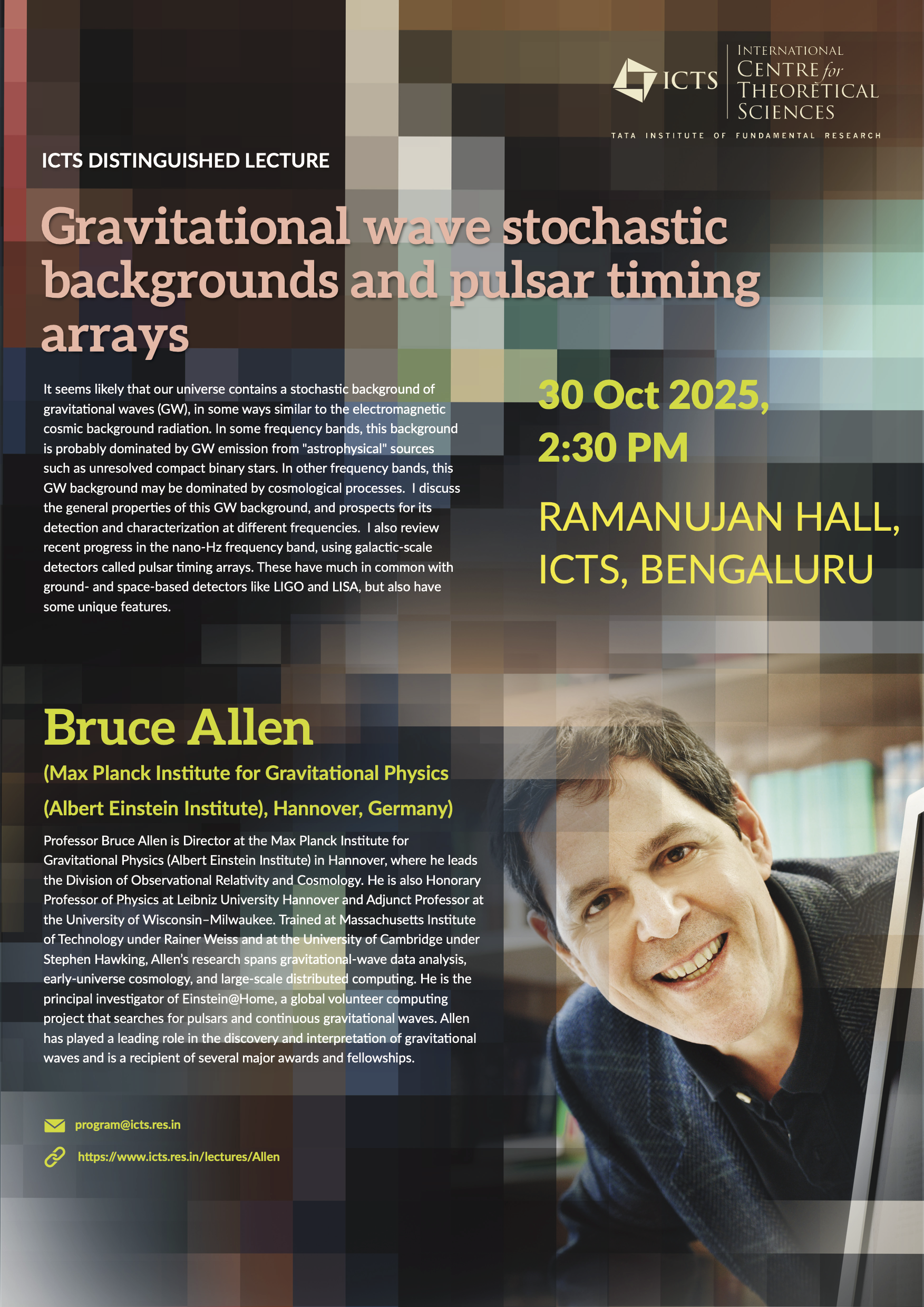
It seems likely that our universe contains a stochastic background of gravitational waves (GW), in some ways similar to the electromagnetic cosmic background radiation. In some frequency bands, this background is probably dominated by GW emission from "astrophysical" sources such as unresolved compact binary stars. In other frequency bands, this GW background may be dominated by cosmological processes. I discuss the general properties of this GW background, and prospects for its detection and characterization at different frequencies. I also review recent progress in the nano-Hz frequency band, using galactic-scale detectors called pulsar timing arrays. These have much in common with ground- and space-based detectors like LIGO and LISA, but also have some unique features.
About the speaker: Professor Bruce Allen is Director at the Max Planck Institute for Gravitational Physics (Albert Einstein Institute) in Hannover, where he leads the Division of Observational Relativity and Cosmology. He is also Honorary Professor of Physics at Leibniz University Hannover and Adjunct Professor at the University of Wisconsin–Milwaukee. Trained at Massachusetts Institute of Technology under Rainer Weiss and at the University of Cambridge under Stephen Hawking, Allen’s research spans gravitational-wave data analysis, early-universe cosmology, and large-scale distributed computing. He is the principal investigator of Einstein@Home, a global volunteer computing project that searches for pulsars and continuous gravitational waves. Allen has played a leading role in the discovery and interpretation of gravitational waves and is a recipient of several major awards and fellowships.
This lecture is part of the discussion meeting "The Future of Gravitational-Wave Astronomy".