



Abstract:
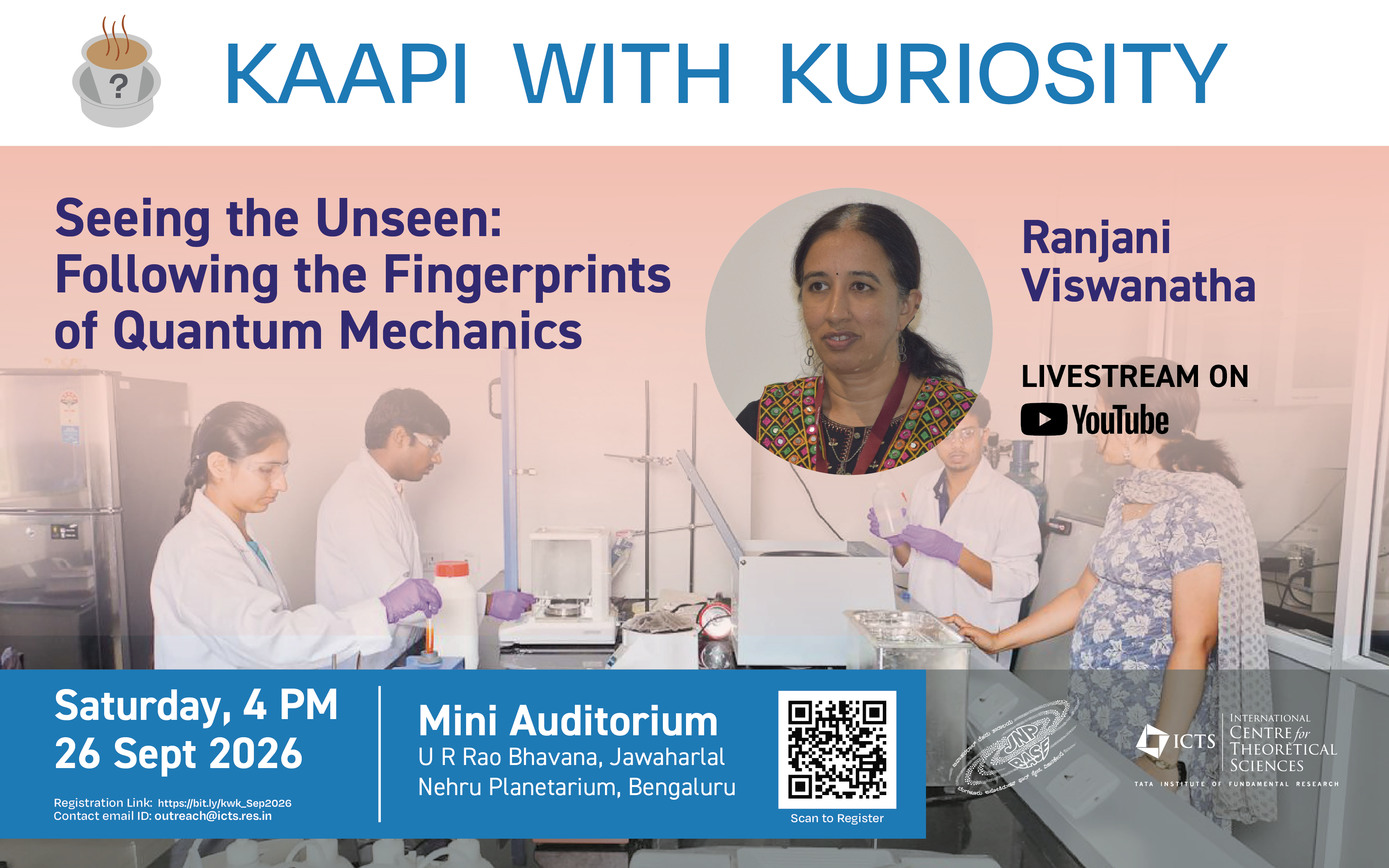
Quantum mechanics can seem mysterious because we often try to understand it using the language and intuition we have developed from everyday life. Perhaps a better approach is to treat it as a new language—one with unfamiliar words, unfamiliar rules and, at first, very little that feels intuitive. But, like learning any new language, perhaps the key is not to begin with the grammar, but to first learn how to listen and recognise familiar patterns. Once we accept this, we can begin to appreciate how this new language describes the world around us.
In this talk, we will take a gentle and visual journey into the quantum world through simple experiments, demonstrations and stories from modern research. Rather than beginning with equations or trying to force quantum behaviour into familiar ways of thinking, we will explore how to recognise the clues that nature gives us and gradually learn what they are telling us. Along the way, we will encounter some of the remarkable ways in which light and matter reveal their quantum nature. The talk will bring together curiosity, experiments and stories from modern research to show that while we cannot see the quantum world itself, we can see its fingerprints everywhere.
About the Speaker:
Prof. Ranjani Viswanatha is a Professor at the Jawaharlal Nehru Centre for Advanced Scientific Research (JNCASR), Bengaluru. Her research lies at the intersection of chemistry, physics and materials science, with a focus on semiconductor nanocrystals and quantum-confined materials. Her group explores how size, composition and structure can be used to control the optical, electronic and magnetic properties of nanomaterials, including quantum dots, doped nanocrystals and perovskites. Her work has received several prestigious national recognitions, including the SERB Women Excellence Award, founding member of Indian National Young Academy of Sciences, and recognition among India’s leading young scientists. She is a Fellow of the Indian Academy of Sciences and in the editorial board of reputed international journals.
Supported by Arista Networks India Pvt. Ltd