



Abstract:
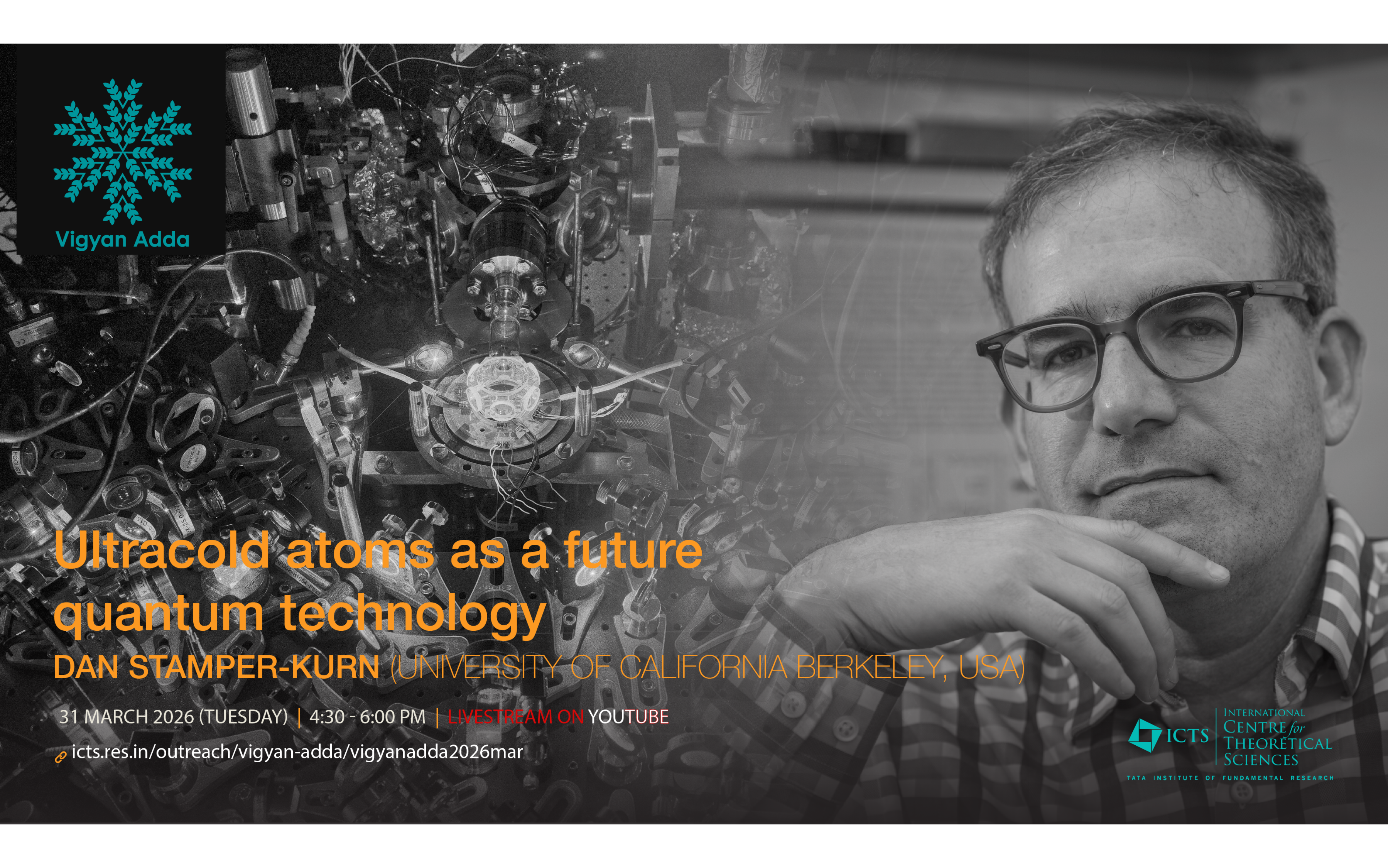
Despite being over 100 years old, quantum mechanics is experiencing a rejuvenation as we gain insight that its central concepts of superposition and entanglement may be the basis of new technologies. This insight has led to a broad exploration of physical platforms in which controlled many-body systems can be reliably engineered. Ultracold atoms, studied for decades primarily as a medium for scientific discovery, are now emerging as a leading platform for many applications of quantum information science. I will summarize some of the ways in which ultracold neutral atoms are being used to advance quantum simulation, quantum sensing, quantum communication, and quantum computation.
About the Speaker:
Dan Stamper-Kurn is a Professor of Physics at the University of California Berkeley and a Faculty Scientist in the Materials Science Division of the Lawrence Berkeley National Laboratory. He earned his PhD from MIT, working with Wolfgang Ketterle on pioneering early experiments on Bose-Einstein condensation. He then performed postdoctoral research at Caltech, working with Jeff Kimble on cavity QED, before establishing his own research program at Berkeley. Stamper-Kurn's research has touched on many topics, including magnetic order in spinor Bose-Einstein condensates, cavity optomechanics, quantum-limited and mid-circuit measurement, geometric effects in materials, and quantum optics with atom tweezer arrays. He has established and now directs the Challenge Institute for Quantum Computation, funded by the National Science Foundation as one of the leading academic centers for quantum information science and engineering. Stamper-Kurn is a Fellow of the American Physical Society, Optica, and the American Association for the Advancement of Science, the co-recipient of the NASA Group Achievement Award for leadership in developing quantum technologies in space, and the recent recipient of the 2025 Senior BEC Award.
Please register to receive Zoom Meeting Link.
Supported by: Arista Networks India Pvt. Ltd.